
13 — From Vision to Accountability: How Asiwaju Olayinka Fasuyi Initiated & Mobilised Ijesaland to Establish Independent Development Monitors
How an idea conceived through the Ijesa Community Development Assembly evolved into a community-driven initiative to promote transparency, responsible governance and measurable development across Ijesaland’s six local government areas.
Sustainable community development requires more than the construction of infrastructure and the delivery of social programmes. It also requires systems that encourage responsible leadership, transparent use of public resources and accountability for development outcomes.
Recognising this important dimension of governance, Asiwaju Olayinka Fasuyi, Asiwaju of Ijesaland, conceived the Ijesaland Independent Development Monitors (IIDM) through the Ijesa Community Development Assembly (ICDA). The initiative was designed to provide a structured, community-oriented mechanism for monitoring local government performance and encouraging development that responds to the needs of the people.
The initiative represents a distinctive milestone in Fasuyi’s record of community stewardship: an effort to strengthen not only development delivery but also the systems through which public administration can be assessed.
Responding to a changing local government landscape
On 11 July 2024, the Supreme Court of Nigeria delivered a landmark judgment affirming the financial autonomy of local government areas. The judgment addressed the direct payment of local government allocations from the Federation Account into their respective accounts.
The development created an important opportunity for grassroots administration. With greater financial autonomy, local governments could potentially respond more directly to community needs and pursue development priorities with greater flexibility.
However, financial autonomy also raised questions about how public resources would be managed, how priorities would be determined and how citizens could assess whether expenditure was producing meaningful results.
For communities, the central issue was not simply whether funds were available, but whether those funds would translate into improved roads, healthcare, education, potable water, employment opportunities, food security and better living conditions.
Fasuyi viewed this emerging governance challenge as an opportunity to develop a preventive, community-based accountability mechanism. Rather than waiting for problems to become public controversies, the proposed institution would encourage regular assessment, constructive engagement and evidence-based reporting on local government performance.
Through ICDA, he conceived the IIDM as a platform intended to serve the interests of communities across the six local government areas of Ijesaland: Ilesa East, Ilesa West, Obokun, Oriade, Atakumosa East and Atakumosa West.
From an idea to an institutional framework
The IIDM concept went beyond a general appeal for transparency. It envisaged an organised monitoring and evaluation framework with defined areas of responsibility, performance indicators and reporting procedures.
The proposed scope covered several aspects of local government administration, including:
- Revenue generation, expenditure and the management of public resources.
- Primary healthcare and community health facilities.
- Education and the condition of public schools.
- Agriculture, food security and related livelihood opportunities.
- Roads, potable water and other essential infrastructure.
- Employment generation and grassroots economic development.
- Governance, transparency and accountability.
- Security of lives and property.
The intention was to connect public administration with observable outcomes in the everyday lives of residents.
Under the original framework, monitoring exercises were envisaged on a quarterly basis, supported by standard performance indicators and the timely publication of findings. Local government chairpersons would also have opportunities to respond to observations and explain the decisions or circumstances behind identified gaps.
This approach was intended to make the process more constructive than adversarial. The goal was to encourage improvement in administration, give communities better information about development performance and create opportunities for public officials to address shortcomings.
Building safeguards for credibility and independence
An accountability institution must earn public confidence through the integrity of its processes. Its findings are useful only when the people it serves can trust the professionalism and independence of those responsible for producing them.
The IIDM framework therefore envisaged safeguards intended to protect the credibility of its monitoring work.
These included provisions relating to declarations of assets and liabilities, restrictions against conflicts of interest and the acceptance of gratification, and service without personal salaries or allowances for the monitors. ICDA was expected to provide operational support, while the monitoring team would be able to carry out its responsibilities independently and report to the Ijesaland community.
These provisions were designed to reduce the risk of personal interests influencing assessments and to encourage a culture of service, professionalism and public responsibility.
The emphasis on safeguards also reflected an understanding that community monitoring cannot rely on good intentions alone. It requires clear rules, consistent documentation, transparent procedures and a willingness to assess performance objectively.
The effectiveness of these safeguards, however, depends on their implementation and continued observance in practice.
Securing traditional rulers’ endorsement
Having conceived the initiative and developed its framework, Fasuyi moved to mobilise the traditional institutions and community stakeholders whose support would be important to its acceptance across Ijesaland.
On 29 August 2024, the late Owa Obokun of Ijesaland, His Imperial Majesty Oba (Dr.) Gabriel Adekunle Aromolaran II, publicly endorsed the IIDM initiative. The occasion was his last public appearance before his passing on 11 September 2024.
The monarch’s endorsement gave the initiative significant traditional-institutional support and underscored the importance of responsible governance and community development.
Fasuyi subsequently led ICDA engagements across the six local government areas, presenting the IIDM concept to traditional rulers, explaining its objectives and seeking support for its accountability-focused approach.
These consultations helped connect the initiative’s institutional design to the lived realities of communities.
Discussions in different parts of Ijesaland highlighted persistent development concerns, including the condition of rural roads, access to functional primary schools and the availability of public health facilities. The conversations demonstrated why residents needed ways to assess local government priorities against the needs they encountered in their communities.
The engagements also provided traditional rulers and other stakeholders with opportunities to express their expectations of elected local government administrations.
Through this process, the IIDM concept moved beyond its initial formulation towards broader community awareness and acceptance.
A professional team representing Ijesaland
The establishment of an independent monitoring initiative required a team with the competence to examine public administration, assess development activities and document findings responsibly.
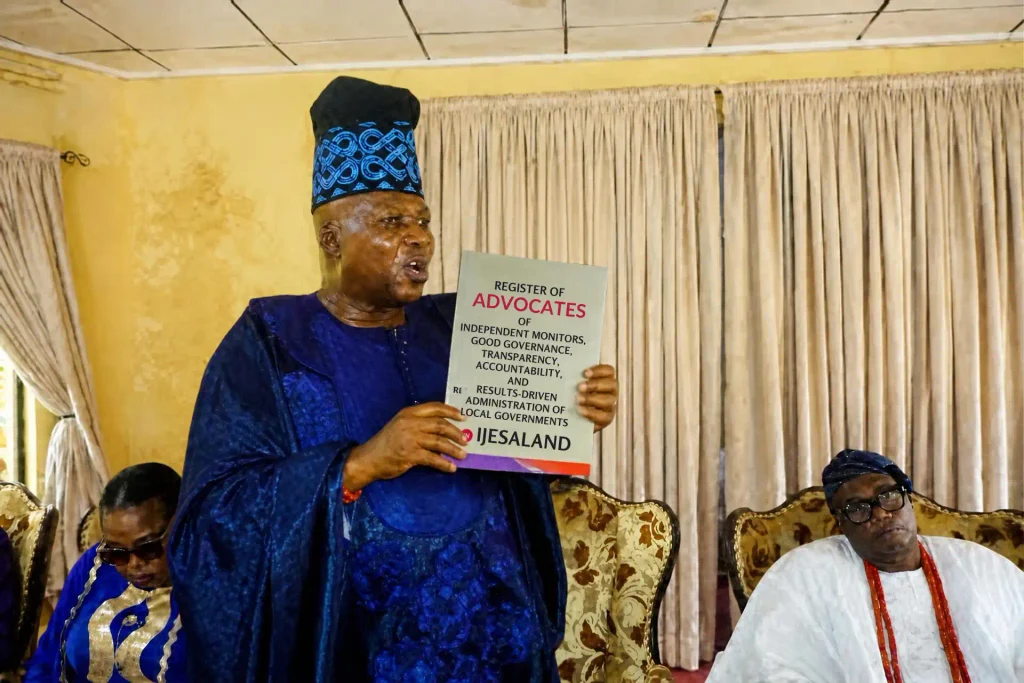
A seven-member monitoring team was assembled, drawing representation from Ijesaland’s six local government areas and bringing together professional expertise in fields including statistics, management, accounting, law, banking and information technology.
Dr. George Adigun Adewoye emerged as chairman of the team, with Sir Ademola Aladekomo serving as vice-chairman and Dr. Olusanya Olajide as general secretary, alongside the other members.
The professional composition was intended to support informed analysis, credible documentation and objective assessment of local government performance.
The Owa Obokun endorsed the team’s composition and offered prayers for the success of the initiative. Its formal inauguration and public presentation provided an organisational structure through which the IIDM’s monitoring responsibilities could be pursued.
The team’s establishment marked an important transition from a concept and mobilisation campaign towards an institution with defined leadership and responsibilities.
An approach based on prevention and constructive engagement
One of the distinguishing features of the IIDM concept is its emphasis on prevention rather than confrontation.
Public accountability is sometimes understood primarily as the identification of wrongdoing after a problem has occurred. The IIDM framework, by contrast, was conceived to encourage regular monitoring that could identify development gaps, document concerns and promote corrective action before challenges became more serious.
For example, monitoring the condition of public schools, healthcare facilities and community roads could help provide a clearer picture of local needs. Reviewing development activities and expenditure could also help communities ask informed questions about priorities, implementation and results.
Local government chairpersons would, under the proposed framework, have opportunities to respond to findings and explain the circumstances surrounding identified challenges.
Such an approach could benefit multiple groups: residents seeking better services, traditional rulers advocating for their communities, elected officials working to improve administration and community organisations interested in sustainable development.
The underlying principle is that accountability should contribute to better governance rather than become an end in itself.
Accountability as a shared community responsibility
The IIDM initiative reflects the belief that grassroots development is strengthened when citizens and community institutions take an informed interest in public affairs.
Government remains responsible for the proper administration of public resources and the delivery of its statutory responsibilities. Community monitoring does not replace the formal institutions of government, audit bodies, law enforcement or other legally established oversight mechanisms.
Instead, a community-based monitoring platform can complement these institutions by helping residents understand development priorities, observe service delivery, document concerns and encourage constructive engagement.
For Ijesaland, the initiative was intended to provide a common framework through which development performance could be discussed across traditional, professional and community institutions.
Its geographical scope was particularly important. By covering all six local government areas, the IIDM sought to encourage a shared understanding of development needs throughout Ijesaland rather than limit accountability discussions to individual towns or communities.
Leadership, integrity and institutional development
The conception and establishment of the IIDM illustrate several principles associated with Fasuyi’s approach to community stewardship.
Vision was reflected in identifying the accountability questions associated with local government financial autonomy and proposing a structured response.
Leadership was demonstrated through the initiative to convene stakeholders, develop a framework and mobilise support for its adoption.
Integrity informed the emphasis on professional competence, conflict-of-interest safeguards and independent assessment.
Transparency shaped the proposed monitoring indicators, documentation procedures and public reporting arrangements.
Accountability defined the initiative’s central purpose: encouraging public administration to produce measurable development benefits for the people it serves.
These principles were reflected not only in the original concept but also in the effort to secure traditional endorsement, assemble a professional team and establish an organisational structure.
At the same time, the initiative’s long-term value will depend on the monitoring team’s ability to work consistently, maintain its independence, produce credible evidence and communicate its findings responsibly.
Beyond projects: Building systems for sustainable development
Many community development milestones are measured by visible outcomes: a completed building, an equipped healthcare facility, a training programme or an empowerment initiative.
The IIDM represents a different but equally important dimension of development. It focuses on the systems and practices that can help ensure public resources are used responsibly and development priorities remain connected to community needs.
The establishment of the initiative therefore represents an attempt to move beyond asking what projects have been delivered to asking how public administration can be assessed, how gaps can be identified and how improvements can be encouraged.
Its significance lies in the combination of an originating idea, an institutional framework, traditional rulers’ endorsement, community mobilisation and the establishment of a professional monitoring team.
The contributions of ICDA, the traditional institution, the IIDM team and participating community stakeholders are integral to this effort. Fasuyi’s role as the initiative’s conceiver and mobiliser forms an important part of that collective record.
A continuing responsibility to Ijesaland
The Ijesaland Independent Development Monitors emerged from a straightforward but consequential proposition: greater financial autonomy at the local government level should be accompanied by stronger attention to transparency, responsible administration and measurable development outcomes.
Through ICDA, Asiwaju Olayinka Fasuyi helped translate that proposition into a community-driven initiative designed to cover all six local government areas of Ijesaland.
The journey from conception to stakeholder engagement, traditional endorsement and the formation of a professional monitoring team represents a milestone in community-led governance reform.
Yet the establishment of an institution is the beginning of its responsibility, not the end of its work. Its lasting contribution will be measured by the credibility of its assessments, the consistency of its operations, its independence and the extent to which its work encourages improvements in local governance.
For Ijesaland, the wider lesson is that sustainable development requires both the delivery of projects and the cultivation of systems that promote responsible stewardship of public resources.
The IIDM initiative reflects an effort to build such a system—one intended to encourage informed citizens, responsive local administration and a stronger culture of accountability across Ijesaland.